The Help by Kathryn Stockett
Hardcover: 464 pages
Publisher: Amy Einhorn Books/Putnam (February 10, 2009)
Language: English
ISBN-10: 0399155341
Synopsis via Amazon:
The Help is set in the early 1960s in Jackson, Mississippi and told from the perspective of three women: Aibileen, Minny, and Skeeter. Aibileen is an African-American maid who cleans houses and cares for the young children of various white families. Minny is Aibileen's confrontational friend who frequently tells her employers what she thinks of them. Her actions have led to her being fired from 19 jobs. Minny's most recent employer was Mrs. Walters, mother of Hilly Holbrook. Hilly is the social leader of the community, and head of the Junior League. She is the nemesis of all three main characters.
Miss Eugenia "Skeeter" Phelan is the daughter of a prominent white family whose cotton farm employs many African-Americans in the fields, as well as in the household. Skeeter has just finished college and comes home with big dreams of becoming a writer; her mother's big dream for her is to get her married, although Skeeter is not interested. What does interest her is that Constantine, the maid who raised her, is nowhere to be found: Skeeter's family tells her that Constantine abruptly quit and went to live with relatives in Chicago but Skeeter wonders if this is true but no one will discuss it.
During the weekly bridge club that Skeeter attends with Hilly, Mrs. Walters, and Elizabeth Leefolt, Hilly discusses her belief that all homes should have separate bathroom facilities for the "colored" help. This discussion awakens Skeeter to the realization that her friends' maids are treated very differently from how white people are treated. She decides that she wants to reveal the truth to the world from the maids' perspectives by writing a book about it. Written in the first person from the perspective of Abileen, Minny and Skeeter, the struggles Skeeter experiences to communicate to the maids and gain their trust is revealed, as well as the issues of overcoming long-standing barriers in customs and laws by all of the characters. The daily lives of Southern homemakers and their maids during the early 1960's in Mississippi are explored. The dangers of undertaking writing a book about African-Americans speaking out in the early 60's hover constantly over the three women.
Book Review:
To avoid giving away spoilers for those who plan to see the film, I will be brief on description. But this post will be long. I read this book two years ago and I read it in two sittings, I hadn't wanted to, but I had to put it down to fix supper, later that night I read it straight through until I finished at 2 am.
This book is about three women, but for me, Minny's POV was the most compelling. She had a tough exterior to all those around her, but in her husband presence she would become fragile and weak. I wanted Minny to stand up for herself, like she does with that sassy mouth of hers to everyone else. But that's not real life and Kathryn Stockett did an excellent job showing us that although Minny could stand up for herself and others, she was still vulnerable in other areas. Minny held such contempt for her employers, that she couldn't hold a job because she couldn't hold her tongue. Yet, Minny had the personality that made you want her to be your friend. You knew she would always have interesting stories to tell after a long days work and she would be your dearest friend in times of need. I envied her friendship with Aibileen. They were like sisters, the love between them was apparent and I wanted to be in their circle. Minny was also the funniest character, she is never sparse on words and once she goes to work for Celia Foote we begin to see a tender and nurturing side of Minny emerge.
Skeeter's character was enjoyable but not my favorite character in the book in the beginning. I did like how Kathryn had Skeeter evolve into this woman who initially had no limitations on thinking differently than her peers, her only issue was she assimilated when in the presence of dominating personalities, but as the book progresses, we see Skeeter develop from a quiet reserved young woman as she not only begins to think differently, but begins to react differently and at times initiates change. She is a woman trying to find herself in a time where people insisted on trying to think for you especially as a young woman. It was nice to see her personal growth blossom and the relationship she develops with Aibileen and Minny become an intimate geniune friendship. The three characters begin to form a bond so deep that Skeeter in the end would rather stay in Mississippi with them, of course Minny and Aibileen had to tell her what she really needed to do.
Aibileen, I loved her spirit and her testimony as a mother. She drew me in and I wanted to console her, surround her with the enduring sentiment that some things would change eventually. I especially like this excerpt from Aibileen's first chapter describing how she felt when her son died. "That was the day my whole world went black. Air look black, sun look black. I laid up in bed and stared at the black walls at my house. Minny came every day to make sure I was still breathing, feed me food to keep me living. Took three months fore I even look out the window, see if the world still there. I was surprised to see the world didn't stop just cause my boy did." Aibileen is the most cautious out of the three and the most humble. Her story just as compelling as Minny, but something about Minny's less than desirable sassy, feisty attitude during an era when most African Americans were either submissive or rebellious in regards to civil rights, left a standing impression. Aibileen is the gentler, more rational side of the coin in their friendship.
Overall, I loved this book. The only thing I didn't like was the overuse of the word
Lord and
Lordy. It's written in an overrung southern dialect. I adapted after a few pages, and after awhile it didn't matter anymore. But every so often when the story was coming off an arc I would noticed the dialect and it could be heavy handed when there isn't any action or conflict happening.
I highly recommend this book and give it
5 STARS *****
----------------------
Film Review of The Help:
I saw the film opening day at the first showing. It performed well with the audience and did an excellent job with keeping with the book for the most part. Some things were changed as I expected. But nothing that really made me feel as if they sold out to their devoted readers. This film has also been making some waves of criticism in the African American literary community. Some African American authors have expressed their displeasure at the fact that the book and film is about African American maids and that it is written by a white writer. The sentiment is why not let black writers write about those experiences if they are to be told. Another sentiment is that we've come along way since maids and mammy stereotypes; as well as why do readers need another book or film where African Americans need white people to liberate them.
Authors Virginia DeBerry and Donna Grant asked in a blog post, "
Would The Help have received so much attention if a black writer wrote about her mother or aunt who actually were 'the help'?"
Author Carleen Brice asked on her blog,
White Readers Meet Black Authors, would a similar book by a black author have done so well? Carleen Brice has an interesting response in which she states, "for the record, I believe all writers have the right to tell stories about people different from them. But I believe part of the reason this book did so well was because the author was white. I have a hard time imagining the word of mouth would have been as great if the author were black. If only because if the author were black, most of y'all wouldn't have even been told about the book."
Author of The Color Purple, Alice Walker, described on her blog,
Alice Walker's Garden, how she avoided the book out of fear that its subject matter would pick at old scabs, when she finally gave in, she was struck by the novel's "healing response to a lifetime of injustice and hurt."
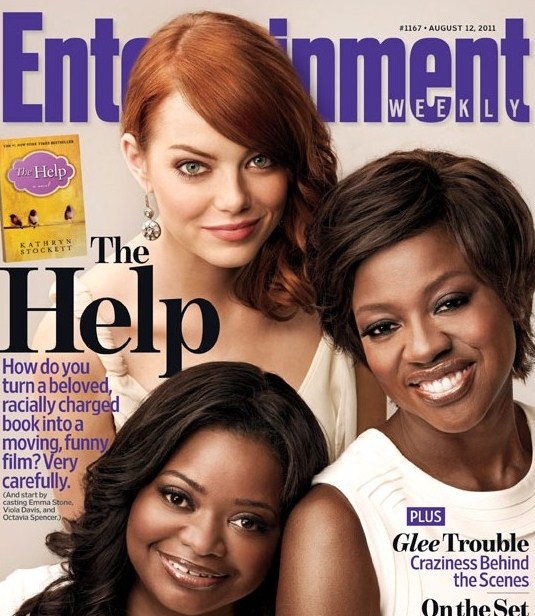
Viola Davis who plays Aibileen had this to say about the criticisms in her interview with
Entertainment Weekly, "People bristle at the maids." But I've played lawyers and doctors who are less explored and more of an archetype than these maids. It's not an issue of Hollywood, It's an issue of culture. Just write a story. Take a risk and tell the most fantastical story that you you've ever wanted to tell and then put it in my lap. There are few movies coming out this year with African American women in them. Very few are being made. Black actresses have enough obstacles in our way without out someone protesting an opportunity for us to show our work on screen. It's one thing if you go see The Help and you don't like it. But give it a chance."
Octavia Spencer who plays Minny says in her interview with
Entertainment Weekly, "I'm thrilled to play this woman. She is a human being with the breadth and depth of emotions and she is a contributing member of society. It shouldn't be why is Viola Davis playing a maid in 2011?' I think it should be Viola Davis plays a maid and she gives the f---king performance of her life. That's why it's imperative that we celebrate this project. Because if it doesn't make money, at the end of the day no one is going to give a s--t about whether Viola did a great job or not. Put your butt in the seat."
My thoughts:
This movie was a joy to watch. I cried four times. I was pleasantly surprised at the tenderness the director took in approaching the subject matter. Producer of The Help, Brunson Green, stated, "this is not a young white girl's story. This is African American women's story." Director of The Help, Tate Taylor, said although the book assumes the point of view of three main characters, Skeeter, Aibileen and Minny, the narration in the movie would belong solely to Aibileen. I think Taylor's decision to do so will pay off in triple dividends because I fell in love with Aibileen in the first five minutes of the film. Aibileen voice carried the sentiment of that time with her cautionary and hesitant displays of action. Her thinking process of weighing the consequences, her faith in God to do something to make change even when you're afraid to spoke to me deeply. In the book, I thought Minny's voice was the dominant voice that lingered throughout the pages, in the film, it is clearly Aibileen's.
Watching Viola Davis give the performance of her life gave me shivers. And I'm thinking Oscar nomination for her in the future. Her performance was not overly dramatic, it was more subtle. The apprehension, discontent, anxiety and protest exuded in the expression of her eyes, the twitching and clutching of her purse, the wiping of sweat off her brow as if she felt someone was always watching her; represented the hesitation that many African Americans had when going against the grain of mainstream's predilection for the status quo. I felt for her as she portrayed Aibileen, I mourned with her, I was angry with her and I laughed with her and Minny. I was amazed that even in the midst of their circumstance, the maids still found pieces of joy. Isn't that what life is all about? Finding the joy in the midst of storms? I can't attest to knowing what the civil rights era was like in the 1960's by first hand experience, especially in Mississippi, but the attention to detail they gave, the empathy and apathy from characters rang true for me from my experience, research and knowledge. I remember one scene where Aibileen has two pictures of her son on her wall, a picture of Martin Luther King and a picture of John F. Kennedy. That was authentic to me because I have seen that same array of photos in many houses growing up, the only thing missing was a picture of Jesus.
The other powerful performances were Octavia Spencer, Cicely Tyson and Sissy Spacek. Octavia Spencer's performance was award worthy, along with Viola Davis, Sissy Spacek and Cicely Tyson. Sissy Spacek did an outstanding job as a mother who held the prominent role in the family but was now being cast down as a child by her daughter Hilly.
Cicely Tyson brief moments as the elderly maid Constantine were memorable. I cried during one of her scenes in the film where she is fired from her job with Skeeter's family. Although, I must admit I will likely cry with anything starring Cicely Tyson because she is just that iconic and esteemed. But Cicely Tyson's presence lends a touch of truth and authenticity. The pain in her face, I felt it. I felt as if she was recounting the pain not just from Skeeter's family, but from her pain in the past. When Constantine's daughter is pulling her away from the door after she is fired, Constantine's hand lingers on the screen, her hand fanned out as if she's being separated from her family. It was powerful. If she had been with Skeeter's family twenty-nine years, what pains did she endure before then? I wanted to know Constantine's story. In the book her story is quite different. The new storyline works well in the movie, but I would've preferred the original as it had more heft.
Not to dismiss Emma Stone, she did a great job as Skeeter and I enjoyed her performance. I think this is her best performance to date, but it is not my favorite performance out of the entire cast of the Help. My favorite scene of Skeeter is when her mother, Charlotte, has given her hair a makeover. Skeeter's reaction in the presence of her mother is priceless. Emma is adorable in this film and I think she will be making some remarkable moments in the future in her acting career.
I remember once saying after I initially read the book that I felt as if Kimberly Elise should play the part of Minny. Well, Octavia Spencer quickly responded to me and said that fortunate for her she got the part instead and would be giving it her all. I was elated. One, Octavia Spencer has never really been in any major starring roles and secondly, this is a fantastic break for her because she is very talented and deserving. Octavia gave Minny the spark, attitude, modesty and depth that the character deserved and needed. Her performance was spot on and never felt forced or overwrought, which could easily be done with this type of character. Most importantly it was believable.
Conclusion:
This is a touching, funny, powerful and poignant story and film. The screen adaption was done well. I could see the details in the smallest things and when I see that I know that there is a tenderness and caring on part of the director and the actors. The Help is a must see film that is thought provoking, hardy yet delicate, sensitive yet uncompromising and if you're open to seeing the labor of love exuding from the talented actresses in it, then it will leave you yearning for more.
As far as the controversy, I am bewildered at how many people dislike the book,
yet have never read it. It would seem best that their opinion would have more weight and credibility if they have at least read the book or saw the film or both if they want to make comparisons. But to be outspoken about something they don't have any knowledge of except hearsay is unfair. It doesn't matter what color skin the author has, write a damn good book and hopefully people will read it.
As an African American reader, I read more books from white authors than I do black. It's not that they are better writers, it's because they write what I want to read...simple supply and demand. The Internet makes it very easy now to find authors from different kinds of backgrounds and ethnicities, so it's not the bookstore not carrying a particular book, at least not in my case. I'm a book reviewer, books generally come to me for free from publishers or authors and the one's I receive are usually not written by African Americans. Also, my favorite African American authors don't put out enough books to keep me constantly reading only their books. I read three to five books a week on average. That's nearly 200 books a year. How many books has Terry McMillan, Bernice L. McFadden and Toni Morrison written in one year? Not enough to keep me occupied with reading only their work.
As far as stereotypes, some African Americans continue to perpetuate these same stereotypes in different forms everyday through television, film and books. Until some people are willing to confront the people living beside them, with them, near them; they can't expect other races or ethnicities to do it for them. That would be like having white people come liberate black people, right? It's amazing how much negative energy is put forth about this book that has employed talented artists yet a community of people won't like it just because. Where is the hoopla and outrage for Basketball Wives??? If you want to create noise, so be it, but make it plausible and meaningful to our ears because the noise created from the displeasure of a white woman writing about black women has got me tuning out.
In regards to The Help having a concept where Skeeter liberates the maids, well I have to disagree. I truly saw it as an independent liberation. Where each woman liberated herself through self empowerment and exploration. Aibileen, Minny and Skeeter used the book as a vehicle to speak freely but they didn't need Skeeter to escape emotional confinement. If anything, Skeeter needed them. At the end of the book, civil rights was still desperately needed, nothing had changed on a macro level. The book gave a glimpse of what it meant in a tangible way for them to be able to express themselves, even if it was done in a concealed manner.
I also think it's excellent to see writers from different races, nationalities and ethnicies writing about other cultures. I don't remember a commandment that only the black race could write about their race and white races had to write about only their race. Or only Jewish people can write about the Holocaust or only men could write about men. I asked my husband these questions, if some very few African American writers are unhappy with a white woman telling a black woman's story, why don't they as African Americans write a white woman's story? What's stopping them? Why have have they narrowed themselves or stuffed themselves into a pigeon hole? Who told them they could only write about black people and why on earth did they believe it? I think if you're a writer, write what you like, write what you love and write what you want to read. Explore the vast literary market of developing and existing sub-genres or create your own. But stop complaining about something you haven't done or tried; like reading the book.
I think Toni Morrison said it best, "if there is a book you want to read but it hasn't been written yet, then you must write it."
I give the film....
5 STARS *****
-------------------------------------------
Favorite Excerpts and Quotes:
Aibileen to baby, toddler and 5 year old Mae Mobley, she often says this to Mae Mobley and Mae Mobley repeats it. It's Aibileen ways of remind the child that she is loved in a house where her mother disregards her.
Aibileen: "You is kind. You is smart. You is important."
Mae Mobley: "You is kind. You is smart. You is important."
Skeeter
"The first time I was ever called ugly, I was thirteen. It was a rich friend of my brother Carlton's over to shoot guns in the field.
'Why you crying, girl?' Constantine asked me in the kitchen.
I told her what the boy had called me, tears streaming down my face.
'Well? Is you?'
I blinked, paused my crying. 'Is I what?'
'Now you look a here, Egenia'-because Constantine was the only one who'd occasionally follow Mama's rule. 'Ugly live up on the inside. Ugly be a hurtful, mean person. Is you one a them peoples?'
'I don't know. I don't think so,' I sobbed.
Constantine sat down next to me, at the kitchen table. I heard the cracking of her swollen joints. She pressed her thumb hard in the palm of my hand, something we both knew meant Listen. Listen to me.
'Ever morning, until you dead in the ground, you gone have to make this decision.' Constantine was so close, I could see the blackness of her gums. 'You gone have to ask yourself, Am I gone believe what them fools say about me today?'
She kept her thumb pressed hard in my hand. I nodded that I understood. I was just smart enough to realize she meant white people. And even though I still felt miserable, and knew that I was, most likely, ugly, it was the first time she ever talked to me like I was something besides my mother's white child. All my life I'd been told what to believe about politics, coloreds, being a girl. But with Constantine's thumb pressed in my hand, I realized I actually had a choice in what I could believe."
Minny
"She's got so many azalea bushes, her yard's going to look like Gone With the Wind come spring. I don't like azaleas and I sure didn't like that movie, the way they made slavery look like a big happy tea party. If I'd played Mammy, I'd of told Scarlett to stick those green draperies up her white little pooper. Maker her own damn man-catching dress."
Aibileen
"I want to yell so loud that Baby Girl can hear me that dirty ain't a color, disease ain't the Negro side a town. I want to stop that moment from coming - and it come in ever white child's life - when they start to think that colored folks ain't as good as whites. ... I pray that wasn't her moment, Pray I still got time."
Skeeter
"Everyone knows how we white people feel, the glorified Mammy figure who dedicates her whole life to a white family. Margaret Mitchell covered that. But no one ever asked Mammy how she felt about it."
"I'd cry, if only I had the time to do it."
-----------------------------------------------------
What did you think about The Help?
Have you read the book, seen the film or both?